


Calls for pay raises continued yesterday as dozens of labor representatives staged a protest in front of the Council of Labor Affairs and pushed for a minimum wage hike to NT$22,115 per month.
With the pay for civil servants, who earn at least NT$35,000 per month, expected to rise by 3 percent, representatives from the Taiwan Labor Front, Taiwan Confederation of Trade Unions, Taiwan Women’s Link and several other civic groups called for an increase in the minimum wage from the current NT$17,880.
“Even though businesses are making more money, they rarely reward workers at the bottom,” Taiwan Labour Front secretary-general Son Yu-lian (孫友聯) said.
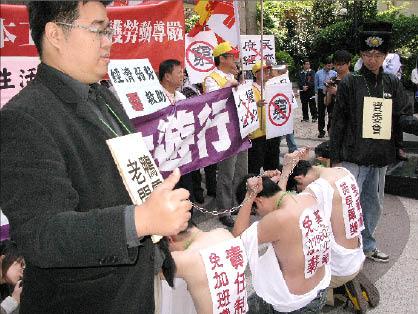
Photo: Liao Chien-ying, Taipei Times
IN NEED
Son said that those who earn the minimum wage are the most disadvantaged workers and have the least negotiating power when it comes to asking for raises.
As such, an upward adjustment of the minimum wage would benefit those who need it the most, Son said.
After being frozen for more than three years, the minimum wage was adjusted from NT$17,280 to NT$17,880 effective Jan. 1 this year. Labor groups called the NT$600 adjustment a “mockery,” saying it was hardly enough to cover rising consumer prices.
Aside from the low minimum wage, workers face a host of other problems, such as death or illness from overwork, unpaid leave and little or no benefits for temporary, contract and dispatch employees, the groups said.
REAL WAGES DOWN
Data from the Directorate--General of Budget, Accounting and Statistics (DGBAS) showed that after inflation was factored in, real wages for workers in Taiwan had declined by more than NT$100 per month from the period prior to the global financial crisis.
Income disparity also reached new highs in 2009, with the top 10 percent of wage earners receiving 28 times the salary of the lowest 10 percent, according to data from the Ministry of Finance.
The income share of the top 5 percent reached almost 75 times that of the bottom 5 percent, an increase from 65 times in 2008, the figures showed.
While average incomes dropped overall in 2009 following a global recession, the lower salaries disproportionately affected low-wage earners, with the bottom 10 percent earning about 20 percent less than they did in 2008.
The bottom 10 percent earned an average total of NT$99,000 in 2009, compared with NT$2.81 million (US$96,800) for the highest 10 percent, who earned about 13 percent less that year than in 2008.
Son said an estimated 5,000 people would take to the streets in Taipei in an annual May Day parade to urge the government to put an end to the problem of the working poor.
ADDITIONAL REPORTING BY CNA

UPGRADE: The Kang Ding-class frigate is replacing its Chaparall missiles with Tien Chien II and Hua Yang VLS, which would provide it with long-range, 360° air defense Taiwan plans to produce 1,200 to 1,376 Hai Chien II missiles (海劍二, Sea Sword II) — also known as TC-2N — to serve as the standard air defense system of the navy’s surface combatant fleet, a source said yesterday. Last week, the Hai Chien II, the naval version of the Tien Kung II missile (天劍二, Sky Sword II), completed a live-fire test in waters off the National Chungshan Institute of Science and Technology’s Jiupeng facility (九鵬) in Pingtung County’s Manjhou Township (滿州). The MIM72 Chaparral and other dated air defense missiles that currently arm Taiwanese ships have inadequate range to combat Chinese

REASONS FOR TRAVEL: An assistant professor said that proposed amendments to penalize drivers if they used drugs overseas would not deter people from traveling People who operate a motor vehicle under the influence of marijuana would have their driver’s license revoked, even if they used the substance while overseas, the Ministry of Transportation and Communications said yesterday, citing proposed amendments to the Road Traffic Management and Penalty Act (道路交通管理處罰條例). The amendments would also authorize the government to revoke the licenses of people determined to have used Category 1 or Category 2 narcotics, even if they were not operating a vehicle while under the influence of drugs, as well as ban them from taking the license test for three years, the ministry said. People aged 18 or

HEAVY WEATHER: Typhoon Jangmi is due to crash straight into the Ryukyus as airlines look to shift flights to larger aircraft or cancel flights to Okinawa entirely Taiwan’s international air carriers announced flight adjustments over the weekend as Typhoon Jangmi is forecast to hit the Ryukyu Islands today and tomorrow. The Central Weather Administration (CWA) upgraded Jangmi from a tropical storm to a typhoon at 8am yesterday, with the eye located 580km south of Naha city. It was moving north at 19kph. Today, China Airlines’ CI-120, CI-121, CI-122 and CI-123 flights between Taoyuan and Naha, Okinawa, have been canceled as well as CI-132 and CI-133 between Kaohsiung and Naha. EVA Air’s BR-112, BR-113, BR-186 and BR-185 flights between Taoyuan and Naha are also canceled. Low-cost carrier Tigerair Taiwan canceled IT-230,
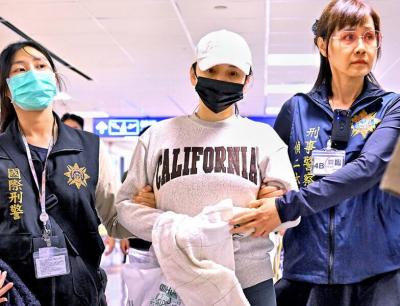
Johanne Liou (劉喬安), a Taiwanese woman who shot to unwanted fame during the Sunflower movement protests in 2014, returned to Taiwan last night after being deported from the US. She is to stand trial in Taiwan for charges involving embezzlement, fraud and drug crimes. The Criminal Investigation Bureau (CIB) said it took her into custody at Taiwan Taoyuan International Airport and would first question her before transferring her to the New Taipei District Prosecutors’ Office. She was arrested upon disembarking a flight from San Francisco that landed shortly before 7pm. Liou absconded to the US in 2019 after jumping bail


 RSS
RSS